
Author Archives: Holland & Hart

April 25, 2013

BUZZ KILL: Employee Legally Fired For Off-Duty Marijuana Use

By Emily Hobbs-Wright & Brad Williams

The Colorado Court of Appeals issued a precedent-setting decision today upholding an employee’s firing for off-duty marijuana use.  Citing federal law, the court held that using pot during non-working hours is not “lawful activity” under the state’s lawful off-duty activity statute.  The decision provides the first direct guidance on terminating workers for off-duty marijuana use since Amendment 64 legalized the drug’s use and possession last November.

The case involved a quadriplegic employee licensed to use pot under the state’s medical marijuana amendment.  The company terminated his employment after he tested positive for drugs in violation of company policy.  The terminated worker claimed that he used the drug within the limits of his license, had never smoked on his employer’s premises, and had never been under the drug’s influence at work. 

In the lawsuit, the terminated worker claimed that the company’s actions violated Colorado’s lawful off-duty activity statute, which prohibits termination for any “lawful activity” conducted off an employer’s premises during nonworking hours.  Before today, Colorado courts had never squarely addressed whether the statute prohibits termination for off-duty marijuana use, when it is permitted under Colorado law. 

Invoking a dictionary definition of the term “lawful,” the Court of Appeals held that “for an activity to be ‘lawful’ in Colorado, it must be permitted by, and not contrary to, both state and federal law.”  Because marijuana use remains illegal under federal law, termination for off-duty pot-smoking does not violate the statute.  The court also noted that its interpretation maintained the “balance between employer and employee rights” reflected elsewhere in Colorado law.

The decision is hugely important for Colorado employers.  Amendment 64, like the medical marijuana amendment before it, did not require employers to “permit or accommodate” pot use, and expressly permitted policies restricting such use.  But before today, courts had never previously decided whether state or federal law defines “lawful activity” under the statute.

The decision may not be the final word.  Further appeal to the Colorado Supreme Court is possible, and other legal theories based on disability and similar laws remain untested.  But for now, the decision provides the best guidance yet on terminating marijuana users, suggesting that courts will protect employers’ rights to enforce drug policies notwithstanding Colorado’s legalization of marijuana.  It further reinforces the importance of employers defining illegal drugs as those prohibited under both state and federal law in drug policies.

This article is designed to provide general information on pertinent legal topics. The statements made are provided for educational purposes only. They do not constitute legal advice and are not intended to create an attorney-client relationship between you and Holland & Hart LLP. If you have specific questions as to the application of the law to your activities, you should seek the advice of your legal counsel.
April 25, 2013

Tips for Complying with Utah’s Internet Employment Privacy Act

By Elizabeth Dunning

Effective May 14, 2013, Utah employers may not request employees or applicants to disclose information related to their personal Internet accounts.  The Internet Employment Privacy Act(IEPA), recently signed into law by Utah Governor Gary R. Herbert, prohibits employers from asking an employee or applicant to reveal a username or password that allows access to the individual’s personal Internet account.  In addition, employers may not penalize or discriminate against an employee or applicant for failing to disclose a username or password.  A similar restriction applies to higher educational institutions through passage of the Internet Postsecondary Institution Privacy Act. 

With enactment of the IEPA, Utah becomes the fifth state to pass legislation that limits an employer’s access to social media accounts, joining California, Illinois, Maryland and Michigan.  New Mexico passed a similar law shortly after Utah and New Jersey’s law passed the legislature and is awaiting the governor’s signature.  A bill introduced in February in the U.S. House of Representatives called the Social Networking Online Protection Act (H.R. 537) is stuck in committee. 

Public Online Accounts Are Fair Game under the IEPA 

The IEPA does not restrict or prohibit employers from viewing or using online information about employees and applicants that the employer can obtain without the employee’s username or password.  Any online information that is available to the public may be accessed and viewed by employers without violating the IEPA.  Consequently, individuals who set privacy settings on their online accounts to allow “public” access effectively opt themselves out of any protections offered by this new law. 

Utah Restriction Applies to Accounts Used Exclusively for Personal Communication 

In prohibiting employers from requiring disclosure of online usernames and passwords, the IEPA draws a distinction between personal Internet accounts and those used for business related communications.  The law only restricts employer access to personal online accounts that are used by an employee or applicant exclusively for personal communications unrelated to any business purpose of the employer.  It does not, however, restrict access to accounts created, maintained, used or accessed by an employee or applicant for business related communications or for a business purpose of the employer.  

In practice, the line between personal and business related accounts may be blurred as many employees use their personal online presence to network and communicate for business reasons.  Consider the sales person who uses his or her LinkedIn account to communicate with potential buyers within a particular industry, or the CPA who posts tax reminders on his or her Facebook page.  Are those accounts accessible under the IEPA since they are not used “exclusively” for personal communications?  A plain reading of the law suggests that may be the case, thereby watering down the potential protections offered by the IEPA to applicants and employees.   

Steps for Complying with the IEPA 

Utah employers should review their HR forms, policies and practices to ensure that they do not ask applicants and/or employees to provide a username or password to their personal Internet accounts.   Train supervisors and managers not to ask for this information as well.  In fact, take the opportunity to remind supervisors and managers not to “friend” subordinates on personal online platforms, such as Facebook.  In addition, reinforce that employees and applicants may not be penalized or treated adversely for failing to provide a username or password for personal online accounts.   

Remember, too, that even though the IEPA does not prohibit accessing an employee’s or applicant’s public social media accounts, viewing such information creates other risks.  Employers may view information regarding the individual’s religion, race, national origin, disability, age, or other protected group status that could give rise to a discrimination claim.  Furthermore, online information is unreliable and ever-changing, meaning that employers should not rely on what they see online when making employment decisions.  To stay out of trouble, consult with legal counsel before viewing or using social media in the employment context.

For more information about permissible actions and potential damages under the Utah Internet Employment Privacy Act, please see our Client Alert.

April 18, 2013

How a Colorado Bill Could Provide Up to 24 Weeks of FMLA Leave

By Brian Mumaugh

Could Colorado employees be entitled to take up to 24 weeks of job-protected leave every 12 months?  Yes, in some circumstances, if the bill recently passed by the Colorado House of Representatives and progressing through the Senate is signed into law.  Although greatly downsized from its original form, House Bill 1222 expands the group of family members for whom Colorado employees are entitled to take leave from work under the federal Family and Medical Leave Act (FMLA) to include care for civil union partners and domestic partners.  In certain circumstances, this expansion could result in an employee being entitled to 24 weeks of FMLA leave in a given year.  Let’s look at what the bill provides.

Leave to Care for Civil Union and Domestic Partners 

Colorado employees currently must look to the federal FMLA for job-protected leave benefits.  Federal FMLA provides an eligible employee up to 12 weeks of leave during a 12-month period to care for a spouse, child or parent who has a serious health condition.  The federal FMLA, however, does not permit leave for an employee to care for his or her civil union partner or domestic partner.  If signed into law, House bill 1222, called the Family Care Act, would allow an eligible employee to take leave to care for the employee’s partner in a civil union or the employee’s domestic partner (if the employer recognizes the person as the employee’s domestic partner or the domestic partnership is registered with the municipality or the state, as applicable).  The employer would be permitted to require the employee to provide reasonable documentation or a written statement of the family relationship, in accordance with the FMLA.  The employer also would be allowed to require the same medical certification as may be required under the FMLA. 

“Double Dipping” of FMLA Leave 

The bill states that FMLA leave taken by an employee under this new law would run concurrently with leave taken under the FMLA and that the new law would not increase the total amount of leave to which an employee is entitled during a 12-month period.  This seems to suggest that “double dipping” would not be permitted.  However, federal regulations provide that the FMLA does not supersede any state law that provides greater leave rights than those provided by the FMLA.  Further, the regulations state that if state law provides for a certain amount of leave, which may include leave to care for a seriously-ill “spouse equivalent,” and leave was used for that purpose, the employee is still entitled to his or her full FMLA leave entitlement, as the leave used under state law was provided for a purpose not covered by the FMLA.  29 C.F.R. § 825.701(a)(3).  On the other hand, if FMLA leave is used first for a purpose that is permitted under both state and federal law and state leave has thereby been exhausted, the employer would not be required to provide any additional leave to care for the “spouse equivalent” during that 12-month period. 

What does this mean?  It means that the order of state vs. federal leave matters.  If leave to care for a seriously-ill civil union partner under state law is requested first, the employee potentially may “double dip” if he or she subsequently requests leave provided under the federal law.  This could lead to a total of 24 weeks of leave in a single 12-month period.  However, if leave that qualifies under the federal FMLA occurs first and the employee takes the full 12 weeks of leave at that time, no leave is available should the employee need to care for his or her civil union partner or domestic partner under state law.   

Next Legislative Steps 

Having passed the Colorado House, the Family Care Act moved to the Colorado Senate where it has passed unamended on second reading.  The Senate needs to pass the bill on third reading to be sent to Governor John Hickenlooper to be signed into law or vetoed.  Rest assured that we will continue to monitor this bill and will pass along updates as warranted.

March 19, 2013

Checklist for Complying with the New FMLA Regulations

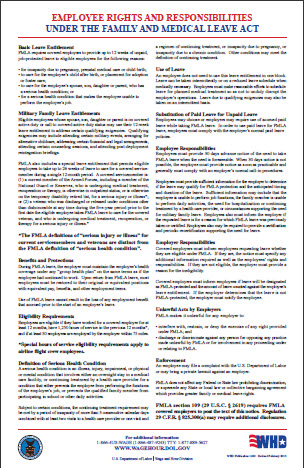
FMLA_posterHave you updated your Family and Medical Leave Act (FMLA) policy and poster?  You should have.  New regulations that implement changes to the FMLA went into effect on March 8, 2013.  Covered employers need to take action now to ensure compliance with the new rules. 

A summary of the changes to the FMLA as well as a checklist for complying with the new regulations is available here.  Be sure to update your FMLA policies, poster, certification forms and notice of rights immediately.  In addition, ensure that your leave administrators, supervisors and human resources personnel are trained on the new rules.  FMLA compliance isn't hard, but it does take work!

February 26, 2013

Who Owns Your Employees’ LinkedIn Profiles? The Answer Might Surprise You.

By Mark B. Wiletsky

If your employees use LinkedIn to establish and maintain contacts for business purposes (such as sales), what happens to those accounts—and contacts—when the employee quits or is fired?  Can an employer who has access to an employee’s LinkedIn profile change her password and replace information in her profile following her termination?  No, says at least one federal judge in Pennsylvania recently, though that case is not yet over.  As explained below, employers should be careful before assuming that they own their employees’ LinkedIn profiles. 

Employer Access to High Level Executive Profiles

Edcomm, Inc., a banking education company, strongly urged its employees to create LinkedIn accounts using their company email addresses as a business networking tool.  It had employee policies governing online postings and specified that if employees identified themselves as an Edcomm employee, they needed to use a specific template that contained pre-approved content about the company and referred to the company’s website.  The company provided a photographer to take professional photos for employee use on their LinkedIn accounts.  It also allowed some Edcomm employees to access, develop and administer the LinkedIn accounts of senior management, such as responding to invitations, inviting new contacts and researching good news stories to include on their LinkedIn pages.

After being acquired by another company, Edcomm, Inc. terminated its company president and founder, Linda Eagle, as well as several other top executives. After her termination, Edcomm locked Eagle out of her LinkedIn profile by changing her password.  It then changed the information on the profile to that of the new acting CEO.

Company Argues LinkedIn Account was Akin to a Client List

Eagle sued Edcomm alleging numerous violations of state and federal law, including invasion of privacy by misappropriation of identity, misappropriation of publicity, identity theft and conversion.  Edcomm argued that the LinkedIn accounts were used to contact new clients and promote the company’s services.  As such, the company claimed that its take over of Eagle’s account was similar to the company keeping possession of a client list after an employee is terminated. 

The Judge didn’t buy it.  At a recent hearing, Judge Ronald Buckwalter stated that Edcomm likely had no right to change Eagle’s LinkedIn password and change her profile information.  He noted that the company had no internal policy that would hand over ownership of employee profiles when employees left the company and that the LinkedIn accounts belonged to the individual employees. 

Be Prepared For An Employee’s Departure

Although it is wise to implement a social media policy to address employee use of company information on personal or company-sponsored social media accounts, you need to be wary of who owns the rights to such information.  First, as indicated in the Edcomm case above, you risk potential invasion of privacy and other claims.  Second, the employee might have rights to the account independent of the employer, as established in an agreement between the service provider and the employee.  At a minimum, consider implementing specific policies that address these issues up front, and consider what services your employees are using to establish and maintain connections with clients.  The fact that contacts are connected through LinkedIn, Facebook, or some other social media site can significantly impact an argument that such contacts are protectable trade secrets.  Lastly, don’t forget that forcing access to employees’ social media can be risky.  Four states have enacted legislation to prohibit or restrict employers from asking for social media access and many other states are currently debating similar restrictions.

February 12, 2013

Minimizing Exposure to Employment Claims: What Every Employer Should Know

Employment lawsuits drain your time, money, energy and perhaps your brand.  Whether you are new to human resources or an experienced manager,  you need to stay abreast of the latest legal issues that could land your organization in hot water. 

 At this Employment Law breakfast primer, two leading employment law experts will lead you through recent court decisions and significant regulatory changes affecting the employer/employee relationship.  We will offer practical pointers on how to manage your workforce while staying out of court.

In this seminar, you will learn: 

  • Red flag issues that often lead to costly litigation.
  • Practical tips for avoiding hiring, firing, and discipline mistakes.
  • Best practices that help you defend an employment lawsuit, if one is filed.

Agenda:

Thursday, March 7, 2013

7:30 a.m. – 8:00 a.m.

Registration and Breakfast

8:00 a.m. – 9:00 a.m.

Program

Westin Westminster CLICK HERE FOR A MAP AND DIRECTIONS
10600 Westminster Blvd  
Westminster, CO 80020
(303) 410-5000

Speakers: CLICK NAME TO VIEW BIO
Steve Gutierrez, Partner, Holland & Hart LLP
Mark Wiletsky, Of Counsel, Holland & Hart LLP

CLE & HRCI Credit Pending

February 12, 2013

FMLA and Facebook Don’t Mix – Vacation Pictures Catch Employee in a Lie

By Mark B. Wiletsky

Co-workers “friend” each other on Facebook all the time.  But sometimes those “friends” turn against their own, providing employers with evidence of wrongdoing.  In a recent case (Lineberry v. Richards), an employee learned the hard way that posting pictures on Facebook can come back to bite you. 

Lineberry, who worked as a full-time Registered Nurse, claimed she needed Family and Medical Leave Act (FMLA) leave after suffering severe pain in her lower back and legs.  Her employer granted her request.

About four weeks into her leave, Lineberry took a prepaid, planned vacation to Mexico.  As many people do today, Lineberry posted photos of her Mexico trip on her Facebook page.  Her co-workers, who had legitimate access to Lineberry’s Facebook page, saw the photos, including pictures of Lineberry riding in a motorboat, lying on her side while holding up two bottles of beer, standing while holding a grandchild on each hip and making trips to Home Depot.  Based on the Facebook postings, the co-workers complained to Lineberry’s supervisors.  Responding to her supervisor’s inquiry about her activities, Lineberry wrote that she had used a wheelchair at both airports while on her trip.

When Lineberry was released to return to work, her employer called her into an investigative meeting.  Initially, she stood by her claim that she had used wheelchairs in the airports on her trip, but after questioning, she admitted that she lied and had never used a wheelchair while on vacation.  A week later, Lineberry was terminated for dishonesty and falsifying or omitting information, a violation of the company’s policies.  Lineberry sued, claiming that her employer violated her FMLA rights. 

Termination Was Based on Dishonesty, Not FMLA

During her deposition, Lineberry admitted again to lying about her use of a wheelchair while on vacation.  Because of the undisputed evidence of Lineberry’s dishonesty, the Court ruled that her employer had the right to terminate her without regard to her leave status.  The Court explained that the FMLA does not afford an employee greater rights that he or she would have if not on FMLA leave.  Because her employer had the right to terminate Lineberry for dishonesty whether or not she took leave, the termination on that basis was permitted by the FMLA.

Employer Lessons

A few key pointers for employers:

1)  Although you should always be cautious before disciplining or terminating an employee on protected leave, keep in mind that the employee’s leave status is not a free pass to lie or commit fraud. 

2)  Of course, before firing or taking disciplinary action against an employee on leave, make sure you have all the facts.  If you have a progressive discipline policy, follow all procedures set forth in the policy.  The employer in Lineberry waited to make its termination decision until it called Lineberry in for an investigative meeting, as was required under its discipline policy.  Failure to follow your own procedures can lead to lawsuits even when your underlying reasons for discipline or termination are justified.

3)  Don’t “friend” your employees so that you can surf their Facebook pages – you could be liable for invasion of privacy.  In addition, you could learn characteristics that you otherwise would not know (e.g., religion, national origin, disability, etc.) that could later serve as the basis for a discrimination claim. However, if others who legitimately obtained information from Facebook report it to you, treat it like any other workplace complaint and conduct an appropriate investigation.

February 11, 2013

Wage and Hour Collective Actions Face Higher Class Certification Standard

By Jeffrey T. Johnson

Employers can thank the Seventh Circuit Court of Appeals for raising the standard that employees must meet when seeking final certification of a Fair Labor Standards Act (FLSA) collective action or state wage and hour law class action.   In an opinion written by Judge Richard Posner, the Court recently refused to certify a proposed class of 2,341 employees, finding that a trial would not be manageable due, in large part, to the differences in damages among the class members.  Espenscheid v. DirectSat USA, LLC, No. 12-1943 (7th Cir. Feb. 4, 2013).  The ruling will likely make it more difficult for plaintiffs to get a wage and hour class certified at the critical final certification stage.

Court Finds No Reason for Different Certification Standards

FLSA collective actions are similar in many respects to class actions brought under Rule 23 of the Federal Rules of Civil Procedure—both permit an individual (or small group) to file suit on behalf of all similarly situated individuals.  One key difference, however, is that Rule 23 sets forth relatively rigorous standards for certifying a class while FLSA collective actions are reviewed under a more lenient “similarly situated” analysis, typically pursuant to a two-step approach.  The Seventh Circuit’s recent decision turns that distinction on its head.

Noting that Rule 23’s procedural provisions are intended to promote efficiency, Judge Posner stated “there isn’t a good reason to have different standards for the certification of the two different types of action.”  Moreover, he wrote that “[s]implification is desirable in law,” especially given the fact that plaintiffs often join a collective action and a class action in one lawsuit.  This collapse of differing class certification standards gives employers beneficial language to argue against collective action certification on the basis of Rule 23 commonality, numerosity and typicality requirements.

Decertification Proper Where Trial would be Unmanageable

The Court went on to reject certification of the proposed DirectSat “class,” finding that the plaintiffs had not presented a feasible trial plan.  The proposed “class” consisted of 2,341 technicians who installed and repaired home satellite dishes.  They worked directly in customers’ homes and were paid on a per job basis, not a fixed hourly wage.  They alleged that DirectSat forbid them from recording time spent on certain tasks, such as filling out paperwork and picking up tools, and that they often worked more than 40 hours a week without being paid overtime. 

Plaintiffs’ arguments to achieve class certification failed.  Judge Posner held that lack of uniformity on the amount of damages suffered by each technician doomed certification.  Plaintiffs’ proposal to use 42 “representative” members of the class to determine damages on behalf of the entire class was rejected.  A further complication was the piece-rate pay basis where those technicians who completed jobs quickly made a higher “hourly” rate than those who worked slower.  In the end, plaintiffs’ counsel admitted that it would “be difficult for Plaintiffs to provide an objective framework for identifying each class member within the current class definitions without making individualized findings of liability.”  The failure to provide a feasible litigation plan to address these complexities doomed the plaintiffs’ effort to obtain final class certification.

Good Development for Employers

This is a significant decision for employers facing wage and hour collective actions.  The standards for final class certification are not very well-developed in most jurisdictions, and Judge Posner’s well-reasoned opinion will carry substantial weight well beyond the Seventh Circuit.  Further, if the more stringent Rule 23 standard is to be applied upon final certification, it is only logical that courts will also begin applying it at the earlier conditional certification stage, thereby making class certification more difficult for plaintiffs.  Judge Posner and the Seventh Circuit have provided employers with an important tool to defend against these types of class and collective claims.

February 4, 2013

HIPAA Omnibus Rule

Have questions about the January 17, 2013 HIPAA Omnibus Rule?  Join Kim C. Stanger of Holland & Hart's Health Law Group in this recorded webinar. 

https://hollandhartevents.webex.com/hollandhartevents/lsr.php?AT=pb&SP=EC&rID=6311067&rKey=f55b55e7eb59d88e

There are significant changes that are reflected in the regulations that will become effective March 26, 2013.  Covered entities and business associates must comply with the new rules by September 23, 2013.  I think you will agree that Kim's presentation is very enlightening.  Enjoy! 

Steven M. Gutierrez

January 30, 2013

EEOC Fails to Prove Credit Checks have Discriminatory Impact

By Mark B. Wiletsky

Is checking an applicant’s credit history discriminatory?  According to the Equal Employment Opportunity Commission (EEOC), using credit checks to screen out applicants may be discriminatory if it has a disproportionately significant impact on a protected group.  Although a court recently dismissed an EEOC lawsuit against an organization concerning its use of credit checks, the case should serve as a reminder to review your own policies and procedures with respect to using background and credit checks in the hiring process, as this is likely not the last time the EEOC or the courts will address the issue. 

EEOC Sues Claiming Use of Credit Checks Has Disparate Impact on Black Applicants

In December 2010, the EEOC sued Kaplan Higher Learning Education Corporation (Kaplan), alleging that Kaplan’s practice of using credit history in making hiring decisions has a disparate impact on Black applicants in violation of Title VII.  In other words, the EEOC asserted that Kaplan’s use of credit histories—while not facially discriminatory—had a disproportionate impact in terms of screening out Black applicants.  Kaplan, however, defended its use of credit histories in the hiring process.  It claimed that it used credit reports to assess applicants for financial and operational positions after discovering system breaches that allowed business officers to misappropriate student funds.  Kaplan asserted that it reviewed an applicant’s credit history to determine whether the individual is under “financial stress or burdens” that might compromise his or her ethical obligations. 

In order to provide statistical analysis showing disparate impact on Black applicants, the EEOC relied on its expert, Dr. Kevin Murphy, to analyze the applicant pool and those rejected due to their credit report.  Because the race of each applicant was not known, the EEOC’s expert tried to use other means to make determinations about the applicant’s race, even when it was not known. 

Kaplan asked the Court to exclude Dr. Murphy’s testimony and report and ultimately, dismiss the EEOC’s case, arguing that Dr. Murphy’s method of determining race was scientifically unsound.  The Court agreed. In the absence of any reliable, scientifically sound evidence to link the use of credit reports to race, the Court granted summary judgment to Kaplan.

Use of Credit Reports Going Forward

In the last four or five years, the EEOC has made an issue out of employers’ use of credit reports and criminal history records in hiring decisions, resulting in the filing of a number of lawsuits.  The EEOC’s track record in these cases, however, is mixed.  In an earlier case alleging disparate impact related to the use of criminal history records, the EEOC finally agreed to dismiss the case after more than three years while the federal court ordered sanctions of over $750,000 against the EEOC for continuing to litigate when it knew of fatal flaws in proving disparate impact.  (See EEOC v. Peoplemark, Inc., No. 08-cv-907 (W.D. Mich. 2008)).  On the other hand, the EEOC was able to obtain a $3.1 million settlement and policy revisions from Pepsi when it challenged Pepsi’s use of background checks in 2011.

Despite the EEOC’s spotty results in proving disparate impact in these background check cases, employers need to be careful and deliberate in how they use credit reports for hiring purposes.  Credit reports should be used only where job-related, such as for applicants seeking positions involving financial responsibility, high level managerial decisions or as required by law.  Conduct credit checks only after making a conditional job offer so as not to weed out candidates prematurely on the basis of credit.  Finally, be aware that eight states currently have statutory restrictions on the use of credit history in employment decisions so if you are located or are hiring in California, Oregon, Washington, Illinois, Maryland, Connecticut, Hawaii or Vermont, you will need to comply with those restrictions.